Dosing Evidence and Stack Rationale
CJC-1295 and ipamorelin act at different points within the growth hormone axis. CJC-1295 mimics GHRH signaling at the pituitary, while ipamorelin activates GHS-R1a, the growth hormone secretagogue or ghrelin receptor. Human studies with other GHRH–GHRP pairings found synergistic growth hormone release, supporting the mechanistic logic of studying both pathways together. This is a rationale for research, not proof that a commercial blend improves muscle, fat loss, recovery, sleep, or longevity.
The phrase “CJC-1295” also creates an important ambiguity. The original clinical compound included a drug-affinity-complex modification that extended its estimated half-life to approximately 5.8–8.1 days. Products marketed as “CJC-1295 without DAC” are generally short-acting modified GRF analogues and should not be assumed to share the same pharmacokinetics, human evidence, or scheduling as long-acting CJC-1295. PS Peptides itself distinguishes its no-DAC formulation from the extended-release DAC version and describes an approximately 30-minute research half-life for the no-DAC component.
The following table separates studied exposure from unsupported internet protocols. It must not be interpreted as a recommended self-injection chart.
| Protocol | Dose | Frequency | Duration | Expected effects | Common side effects |
| CJC-1295 alone, long-acting clinical-research form | Human trials particularly identified 30 or 60 mcg/kg as relatively well tolerated | Single dose, followed in one study by two or three weekly or biweekly doses | Trials lasted 28–49 days | Dose-dependent GH elevation for at least six days; IGF-1 elevation for approximately 9–11 days after one dose and up to 28 days after repeated exposure | Injection-site reactions, flushing, headache or fluid-related symptoms may occur; FDA additionally reports increased heart rate and systemic vasodilatory reactions |
| Ipamorelin alone, early PK/PD research | Five IV infusion levels from 4.21 to 140.45 nmol/kg were studied in healthy men; a separate postoperative trial used 0.03 mg/kg IV | Fifteen-minute single infusions in the PK study; twice daily in the postoperative study | Single exposure or up to seven postoperative days | A discrete GH pulse peaking at about 0.67 hours, with an estimated terminal half-life near two hours; postoperative gastric-motility efficacy was not established as a wellness benefit | A reliable “common” profile for subcutaneous wellness use has not been established; FDA cites immunogenicity concerns and serious IV adverse events, including death |
| Combined CJC-1295 and ipamorelin | No FDA-approved or clinically validated fixed combined dose | No validated frequency | No validated cycle length | Theoretical amplification of GH release through complementary GHRH and GHS-R1a signaling | Combined risks are not adequately characterized; possible additive endocrine, glucose, cardiovascular, fluid-retention and injection-related effects |
These numbers cannot be converted directly into an informal “beginner protocol.” The CJC-1295 trial involved a particular long-acting investigational molecule, while the ipamorelin studies used intravenous administration. Changing the molecule, salt, delivery route, formulation or combination can change absorption, exposure and risk. The FDA specifically warns that peptide aggregation, impurities and manufacturing characteristics may affect immunogenicity and product behavior.
Qualified researchers comparing formulations may review PS Peptides’ CJC and ipamorelin research options. Apply PEP25 where eligible. The vendor states that its materials are for lawful laboratory research, not human consumption.
Expected Benefits and Timeline
The strongest human evidence concerns hormone biomarkers rather than visible body-composition outcomes. In healthy adults, long-acting CJC-1295 produced a two- to tenfold increase in mean plasma growth hormone and a 1.5- to threefold increase in IGF-1 after a single injection. In the early ipamorelin pharmacokinetic study, growth hormone peaked approximately 40 minutes after infusion and then declined toward negligible concentrations.
Claims involving lean-mass gains, abdominal-fat reduction, faster injury recovery, improved sleep, better skin, anti-aging or enhanced exercise performance remain substantially more speculative. Benefits of medically prescribed growth hormone have been demonstrated in properly diagnosed growth hormone deficiency, but those findings cannot automatically be transferred to healthy users or to unapproved secretagogue stacks. In healthy older adults, growth hormone trials found modest body-composition changes accompanied by higher rates of edema, joint symptoms, carpal tunnel syndrome and impaired glucose regulation.
The following chart is a conservative research interpretation, not a promise of clinical results:
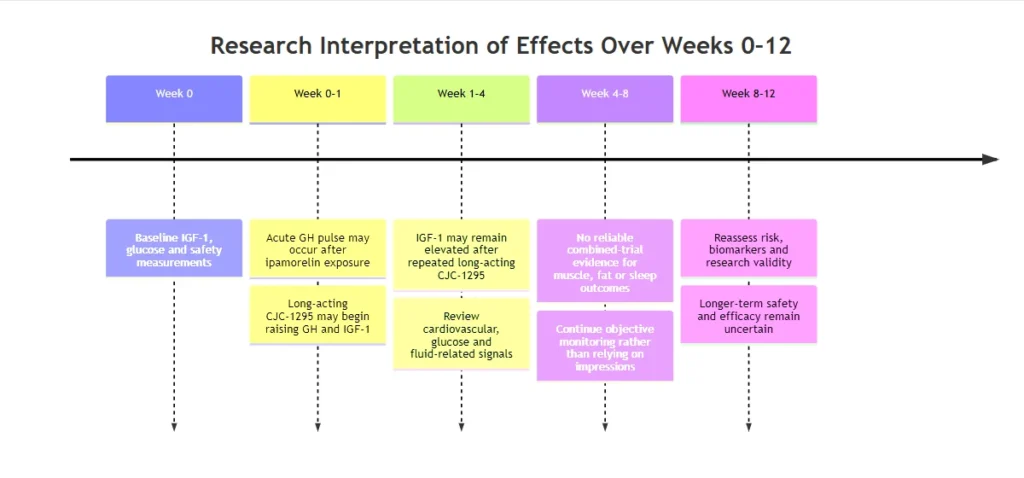
A reasonable evidence hierarchy places hormone changes first, measurable body-composition changes second, and subjective claims such as “rejuvenation” last. An increase in GH or IGF-1 is not itself proof of a net health benefit, particularly when excessive GH/IGF-1 signaling can contribute to edema, insulin resistance and other adverse effects.
For laboratory teams studying GH-axis biomarkers, see current PS Peptides research materials and use PEP25 at checkout. Promotional savings should never replace protocol review, ethics approval or qualified scientific oversight.
Safety, Contraindications, and Monitoring
There is no FDA-approved package insert defining contraindications for a CJC-1295–ipamorelin stack. Consequently, lists presented online as definitive contraindications are usually extrapolated from growth hormone physiology, clinical growth hormone guidelines and general investigational-drug safeguards.
The clearest risk categories include active malignancy, uncontrolled glucose disorders, significant cardiovascular disease, untreated pituitary disease and unexplained elevated IGF-1. The Endocrine Society considers active malignancy a contraindication to growth hormone treatment, notes that GH can increase insulin resistance, and recommends monitoring thyroid and adrenal function in medically treated adults. Applying those principles to unapproved secretagogues is a precautionary inference rather than an official indication-specific guideline.
Pregnancy, breastfeeding, childhood use, recent cancer treatment and concurrent use of insulin, glucose-lowering drugs, corticosteroids or other hormone-modifying agents require specialist assessment. Absence of evidence should not be interpreted as safety in these groups.
Potential adverse effects associated with growth hormone pathway stimulation include swelling, joint or muscle discomfort, numbness or tingling, carpal tunnel symptoms, headache, changes in blood pressure, impaired fasting glucose and insulin resistance. Injection-related formulations add risks of infection, contamination, incorrect concentration and immune reactions. The FDA’s compound-specific concerns include tachycardia and systemic vasodilation for CJC-1295 and possible immunogenicity for both peptides.
A medically supervised monitoring framework would ordinarily consider baseline and follow-up IGF-1, fasting glucose or HbA1c, blood pressure, weight, edema, neurological symptoms and injection-site reactions. Thyroid and adrenal testing may be appropriate when pituitary dysfunction is suspected. Growth hormone guidelines recommend monitoring during titration and periodically thereafter, but those recommendations were developed for approved recombinant growth hormone treatment in diagnosed deficiency—not for an unapproved peptide stack.
Palpitations, chest pain, fainting, severe headache, breathing difficulty, generalized swelling, signs of infection or an allergic reaction warrant urgent medical evaluation rather than dose adjustment through an online calculator.
Legal Status and Sourcing Quality
In the United States, neither CJC-1295 nor ipamorelin is FDA-approved for bodybuilding, anti-aging, sleep, recovery or routine hormone optimization. FDA materials place both substances among bulk ingredients presenting significant safety concerns for compounding, and a 2024 advisory committee voted against including ipamorelin acetate on the applicable 503A bulks list. Regulatory details may continue to evolve, but “research use only” does not transform a product into an approved human drug.
Competitive athletes face an additional restriction. The 2026 World Anti-Doping Agency Prohibited List covers CJC-1295 among growth hormone-releasing factors and ipamorelin among growth hormone secretagogues. They are prohibited at all times in WADA-governed sport, and USADA has issued sanctions involving both compounds.
Sourcing quality should be assessed independently of promotional language. Useful documentation includes a batch-specific certificate of analysis, identity confirmation by mass spectrometry, quantitative purity testing, lot traceability and—where relevant to the research design—endotoxin, heavy-metal and microbial testing. A purity percentage alone does not demonstrate sterility, correct biological activity or suitability for human injection.
PS Peptides states that its CJC no-DAC and ipamorelin spray product is US-manufactured, tested at 99% or greater purity, and accompanied by batch-specific HPLC, mass-spectrometry, heavy-metal and endotoxin documentation. These are vendor claims that researchers should verify against the actual lot documents rather than treating the website statement as independent proof. The same page explicitly limits the product to laboratory research and says it is not intended for human consumption.
Qualified purchasers can visit PS Peptides for batch-documented research products and enter PEP25. Confirm that purchasing, possession, shipping and intended research use comply with institutional and local requirements.
Practical Takeaways for Beginners
The central conclusion of any rigorous article targeting “cjc 1295 and ipamorelin dosing” should be that there is no universally recommended human dose. A small trial of long-acting CJC-1295 and early intravenous ipamorelin research cannot validate the fixed microgram schedules frequently circulated by vendors, clinics, forums or social-media creators.
Beginners should first determine whether they are reading about CJC-1295 with DAC or a short-acting no-DAC analogue. They should then identify the studied species, administration route, formulation, outcome and duration. A rodent body-weight study, an intravenous postoperative trial and a subcutaneous endocrine trial answer different questions and should not be blended into one consumer protocol.
For legitimate laboratory work, define a measurable hypothesis, document baseline values, pre-specify stopping criteria, use a consistent batch, protect samples according to verified stability data and record every deviation. PS Peptides recommends refrigeration and protection from light and heat for its opened spray products, but handling requirements should be verified for each exact formulation and lot.
For personal health decisions, the practical starting point is not an online peptide dose. It is clinical evaluation for symptoms, medication review, glucose assessment, IGF-1 interpretation and, when growth hormone deficiency is genuinely suspected, validated endocrine testing. The Endocrine Society notes that growth hormone deficiency usually requires confirmation through stimulation testing and that treatment should be individualized according to response, adverse effects and IGF-1—not copied from a generalized internet chart.
For lawful, qualified in-vitro research, browse the PS Peptides laboratory catalog and use coupon code PEP25 where applicable. The responsible conclusion remains unchanged: discounts and product availability do not establish clinical safety, and no CJC-1295–ipamorelin regimen should be presented as an approved medical protocol.